Working product concept · South Florida
From fragmented building records to clear, accountable action.
An AI-assisted operating layer that reads reports, spreadsheets and email, then produces reviewed requirements, assigned work and board-ready decisions.
Built for the moment a deadline approaches, management changes or the board asks: where do we stand?
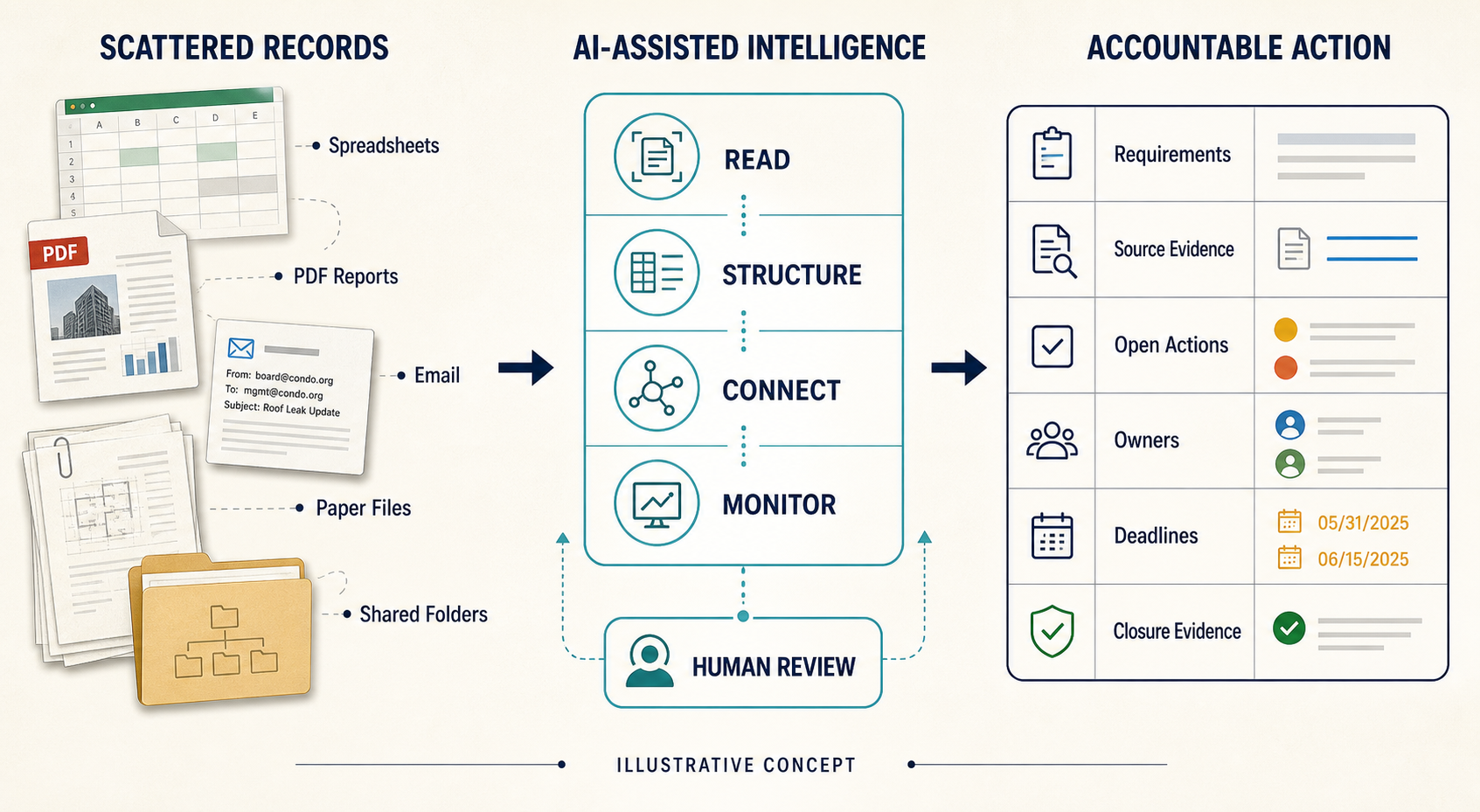
At a glance
What fails, what the client receives and what the pilot must prove.
The first test starts with one building.
- 01What fails today?
- The records often exist, but status lives across PDFs, Excel trackers, email chains, shared folders and individual memory. Missing follow-through surfaces when time is short and options are narrower.
- 02What does the client receive?
- A reviewed Building Baseline with five usable outputs:
- Building requirements register
- Evidence and missing-record index
- Open-action register
- 30/60/90-day deadline outlook
- Board decision brief
- 03What does the first pilot prove?
- One real building tests whether the team can create those outputs accurately, explain every material item and update them without rebuilding the analysis from scratch.
Where the process breaks
The operating problem
Recommendations and dates sit in PDFs, Excel trackers, email chains, shared folders and individual memory. When staff or management changes, teams repeat the work. Near a deadline, they may discover that no one completed the next step — leaving less time to act and potentially expensive consequences.
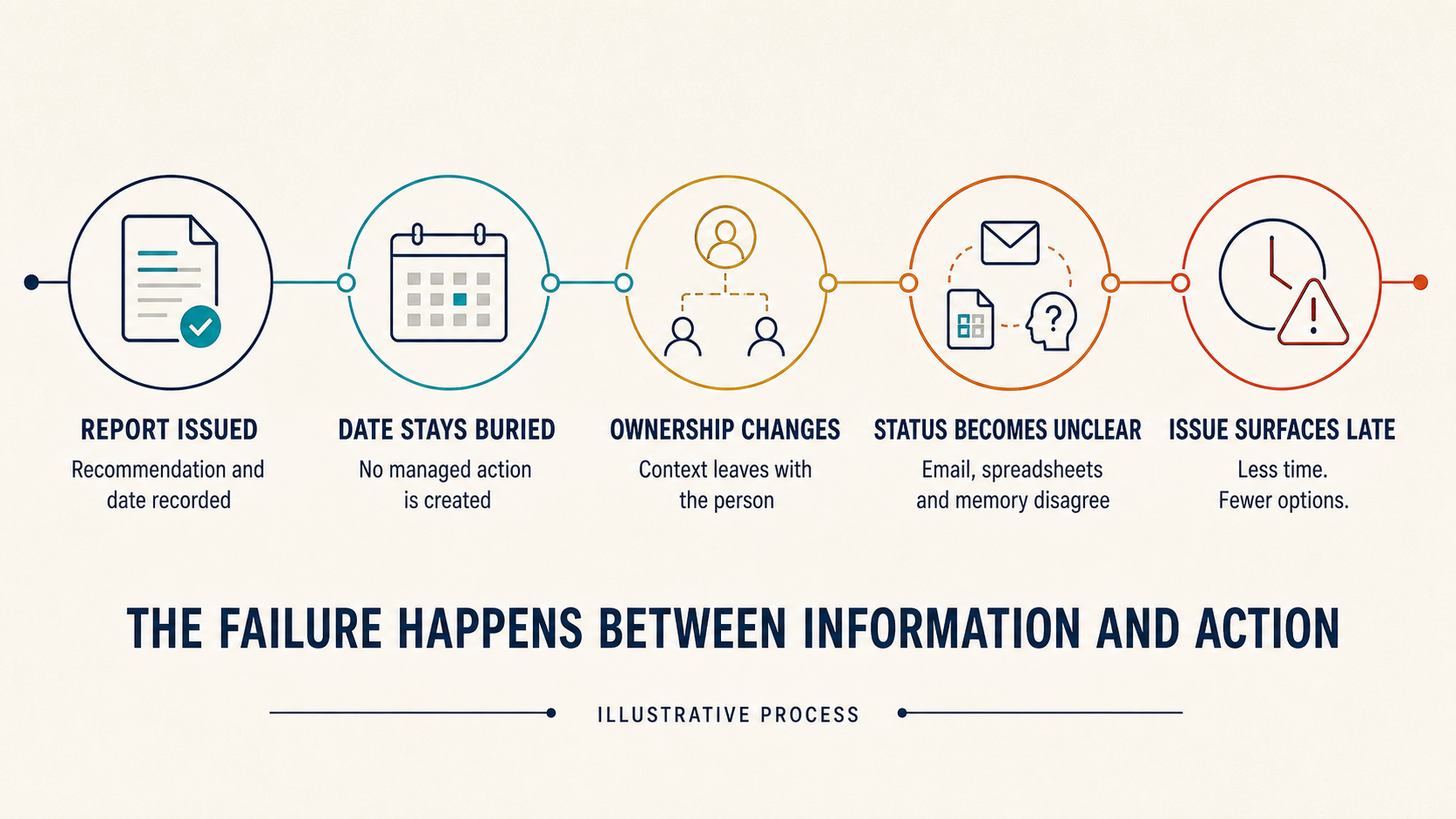
A folder can preserve the past. It cannot manage what needs to happen next.
How the product creates value
From source evidence to accountable action
This is not another document repository. It creates and maintains a reviewed record for each building: what may apply, what the records prove, what is missing, what must happen next, who owns it and what will close it.
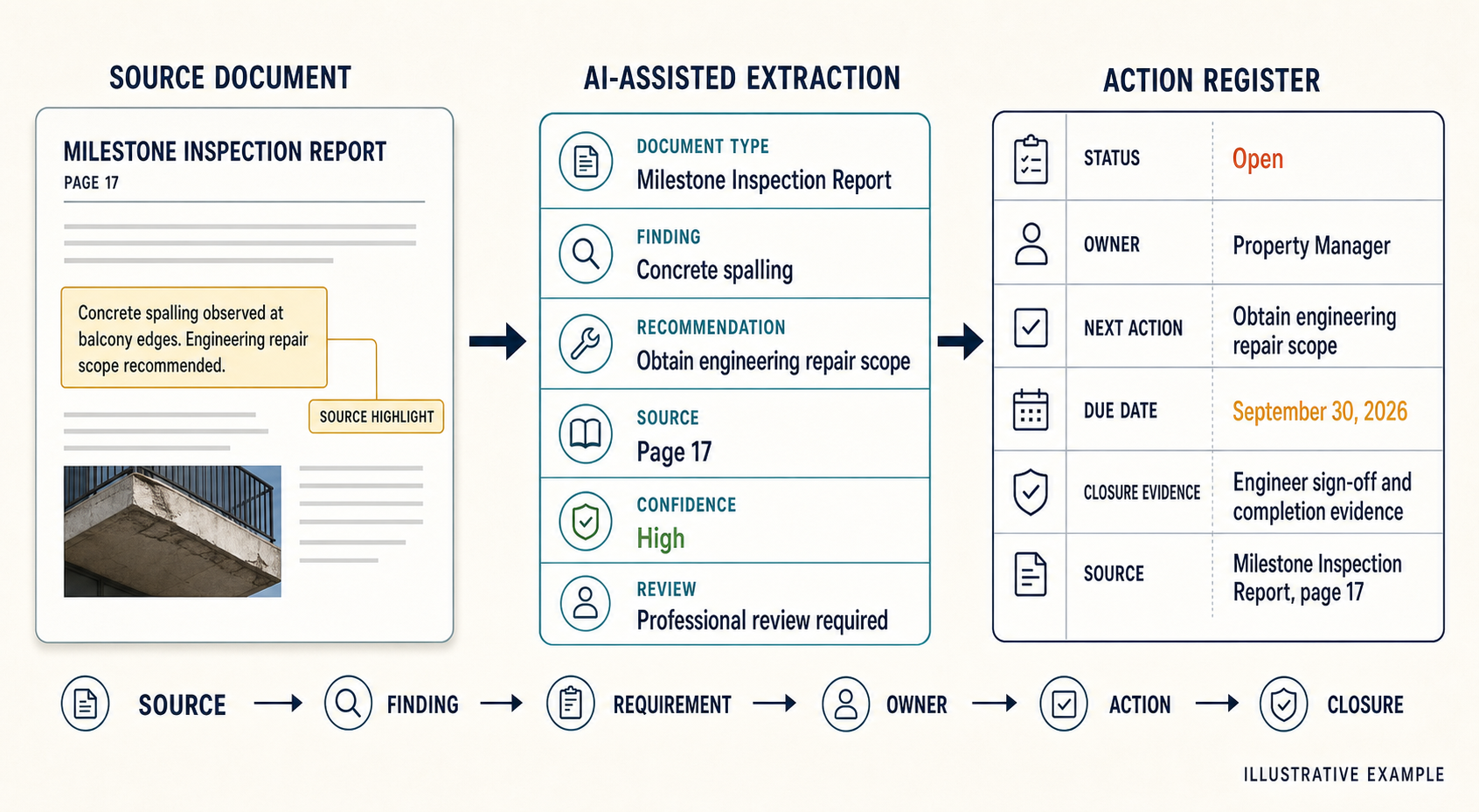
Every material item should contain:
- Requirement or finding
- Source document and page
- Applicability and verification status
- Current status
- Responsible owner
- Next action
- Due date
- Evidence required for closure
Each update should answer four questions:
- What changed since the last review?
- What is overdue or approaching?
- What requires a decision?
- What can now be verified and closed?
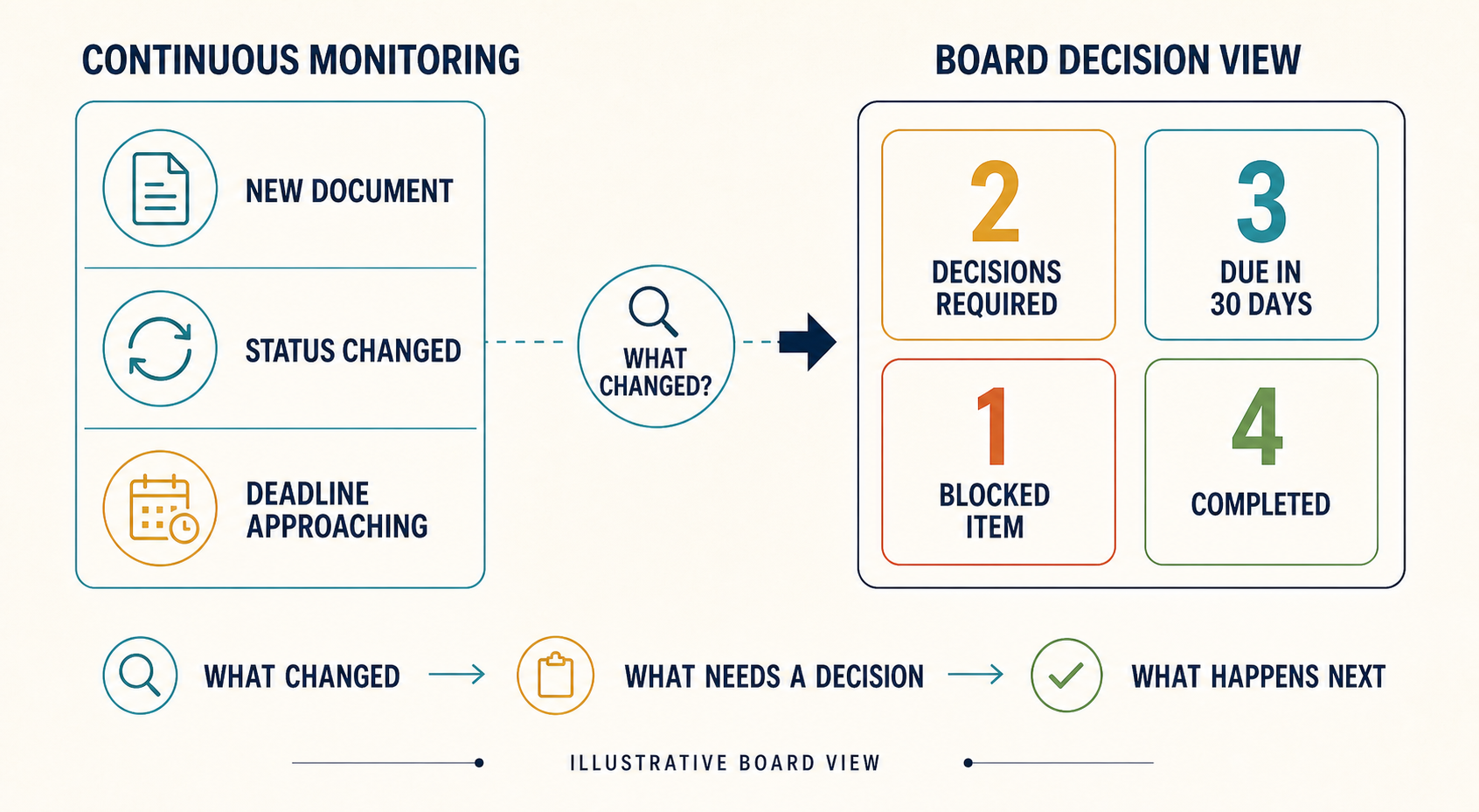
Different people use the same record for different decisions.
- Daily operator
- Property manager or management team
- Decision audience
- Board
- Reviewer
- Engineer, attorney or another qualified specialist
- Potential buyer
- Association or management company
- Portfolio user
- Management company or multi-building owner
The operating boundary
AI prepares the record. Qualified people approve the conclusions.
| AI assists with | People remain responsible for |
|---|---|
| Read, classify and structure records | Validate requirements and professional findings |
| Extract dates, amounts and recommendations | Confirm applicability and correct the extraction |
| Link sources, flag changes and monitor dates | Assign responsibility and approve decisions |
| Draft status and board summaries | Verify completion and authorize closure |
Scroll horizontally to read the full comparison.
Important boundary. The system does not issue autonomous legal, technical or engineering opinions. Material items keep their source and verification status so qualified people can review them before a decision or closure.
The first proof
What the first pilot should prove
The pilot should produce a useful Building Baseline for one real property, then show how much review, correction and recurring work the process requires.
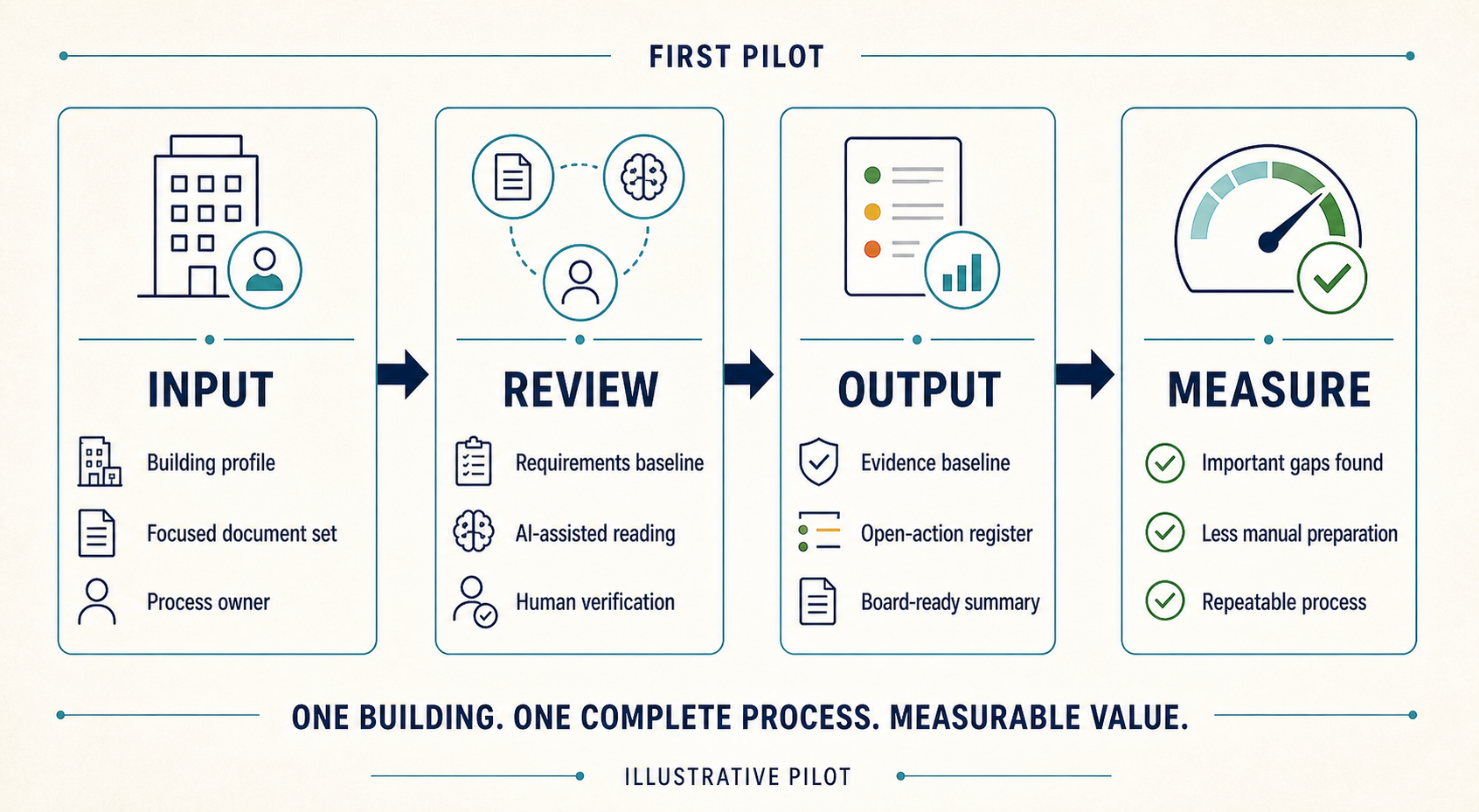
One complete test
- 1 building
- 3–5 priority document categories
- 1 named operational owner
- 1 reviewed requirements and action register
- 1 board-ready summary
- 1 final decision: continue, revise or stop
Evidence for the next decision
- Important gaps found
- Items corrected after human review
- Hours required to create the Baseline
- Hours required to prepare a board update
- Specialist-review effort
- Decisions supported
- Willingness to continue with Monitoring
Out of scope: accounting, payments, resident communication, voting, vendor marketplaces, autonomous professional opinions and replacement of the existing management platform.
Market, competition and commercial scale
Clients already buy compliance and association software.
The market includes Florida compliance tools, broad association platforms and enterprise systems for management companies. The commercial question is where a reviewed building-record and action layer earns its place.
These Florida DBPR figures show scale, not addressable buyers; requirements vary by building, association and jurisdiction.
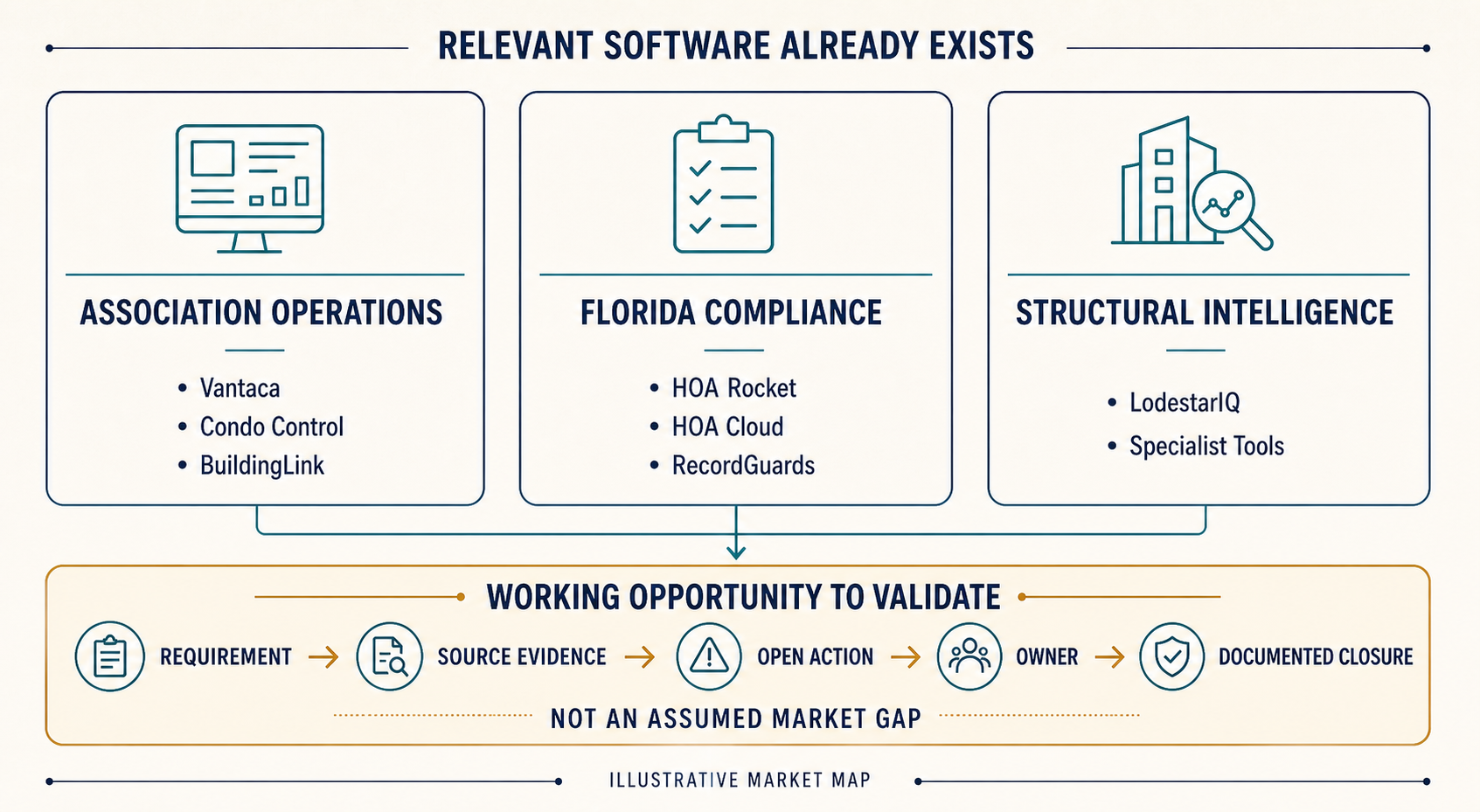
Public pricing snapshot
Public pricing reviewed August 26, 2026. Entry prices are not directly comparable because the products cover different work.
| Product | Product category | Public price or pricing method | What the price helps us understand |
|---|---|---|---|
| HOA Rocket | Florida compliance | $149 per association per month | A focused compliance product can support a clear association-level subscription. |
| HOA Cloud Compliance Shield | Florida compliance | $200 per association per month up to 300 units; $299 for 301+ units | Compliance can be sold separately from the full management platform. |
| HOA Cloud Platform | Full association platform | $195 monthly base plus unit pricing; published 100-unit example: $695 per month | Accounting, payments and resident operations support a materially higher package price. |
| HOA Cloud portfolios | Management-company platform | $1.75 per door per month plus $200 per association per month | Portfolio pricing can combine per-unit and per-association charges. |
| Condo Control | Broad community-management platform | Starts at $67.50 per month; final pricing depends on community size and scope | A public entry price can lead into a tailored platform quote. |
| RecordGuards | Florida compliance and statutory workflows | Public list price not available; quoted individually | Early compliance products may price around association size and obligations. |
| LodestarIQ | Portfolio compliance intelligence | Early-access assessment carries no charge; standard list price not published | The category is still testing product scope and buyer value. |
| Vantaca | Management-company operating platform | Public list price not available; quoted individually | Enterprise workflow platforms use sales-led pricing. |
| BuildingLink | Resident and building operations | Estimator provides an indicative cost; exact price is quoted individually | Community size, package and integrations materially affect price. |
Scroll horizontally to read the full comparison.
Limited reference point. The simple unweighted average of three publicly advertised entry prices — $149, $200 and $67.50 — is approximately $139 per month. It is not a market-wide average and does not compare equivalent product scope.
Software budgets already exist. The open question is whether buyers will fund a reviewed building-record and action service alongside their current systems.
The most credible entry may be a focused Baseline and Monitoring service that complements accounting, payments, resident communication and general property-management platforms.
Illustrative commercial model
The model separates the one-time work required to create a trusted Building Baseline from the recurring work required to keep active buildings current.
- Monthly recurring revenue
- $7,475
- Annual recurring run-rate
- $89,700
- Baseline revenue
- $62,500
- Illustrative annual gross value
- $152,200
One management company may introduce many associations. In this model, 25 active associations means 25 active billing units unless a portfolio discount applies.
This illustration assumes the selected buildings are active for a full 12-month run-rate and that each new building receives a Baseline. It excludes onboarding ramp, churn, portfolio discounts, delivery and specialist-review costs, support, sales costs, partner or revenue shares, taxes and payment processing.
Product sequence
Longer-term direction and commercial model
Build the single-building record first, prove that it stays current, then use consistent data across a portfolio.
- Building Baseline
- Document inventory
- Reviewed requirements register
- Source and evidence map
- Missing-record list
- Open-action register
- Initial board brief
- Continuous Monitoring
- New-document review
- Change and deadline monitoring
- Action-status updates
- Verification and closure tracking
- Recurring board brief
- Portfolio Intelligence
- Cross-building deadlines
- Shared risk patterns
- Workload outlook
- Evidence-quality differences
- Management-level reporting
Portfolio Intelligence follows only after Baseline quality and Monitoring repeatability are proven. The product should initially complement, not replicate, existing platforms.
Commercial structure
Price the initial build separately from recurring maintenance.
One-time
Initial Building Baseline
Working hypothesis: $2,500 per building. The pilot must show whether that fee covers document preparation, review and delivery at a repeatable standard.
Recurring
Ongoing Monitoring
Working hypothesis: $299 per active building per month. The fee covers new-record review, deadline and status updates, closure tracking and recurring board summaries.
Pricing drivers to measure before setting final tiers
- Document volume
- Document quality
- Building complexity
- Number of active items
- Reporting frequency
- Specialist-review effort
- Portfolio size
Questions for discussion
These questions test the product, pilot and pricing assumptions that industry experience can confirm or correct. Answer them here or use them as a discussion agenda.
- Allow approximately 15–20 minutes if answering independently.
- You may skip any question and return later.
- Fields marked optional can be left blank.
- Answers are not submitted automatically.